Does Scientific Evidence Support Fermented Foods' Popularity?
Posted:
2026-05-01
What’s happening?
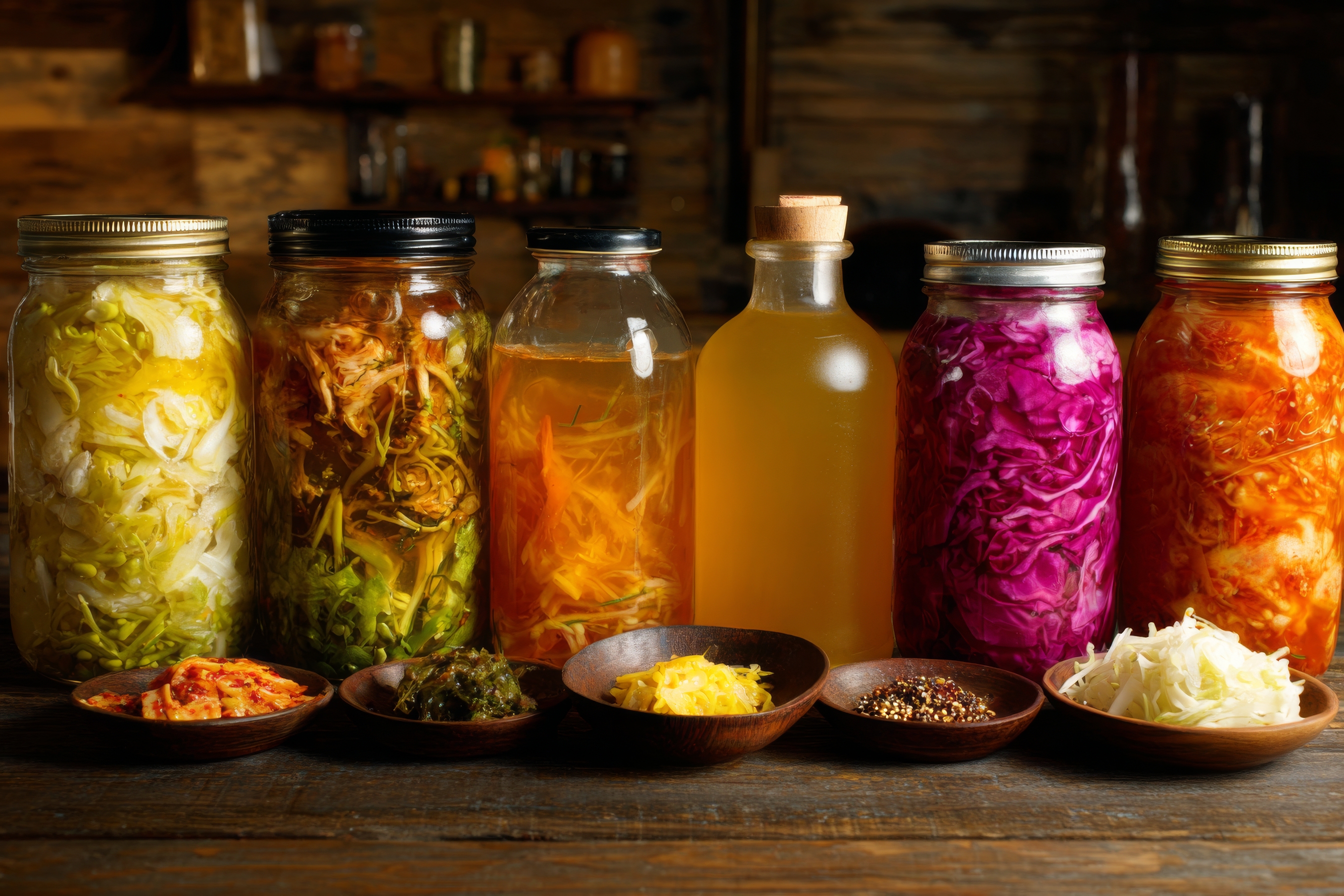
2026 is the year of the cabbage! This trend is fuelled in part by claims that cabbage in its fermented form, sauerkraut and kimchi, and other fermented foods like yogurt, kefir, tempeh and some kombucha fermented teas can potentially improve digestion, immunity and possibly mood (1,2,3).
Fermented foods or beverages are “those made through desired microbial growth and enzymatic conversions of food components” (3). They have been around for thousands of years (e.g. bread, cheese and wine), long-established in many country cultures and traditions, often due to improved flavour and appearance of food and to preserve food (3, 4). Since microbes are essential to fermentation, pickled foods (produced through submersion in vinegar) do not meet the definition of a fermented food (5). As an example, sauerkraut can be pickled or fermented with live microbes (i.e. lactic acid bacteria). Other fermented products with live microbes present when consumed in the unheated food include dairy products (yogurt, cheese, kefir, buttermilk), soy products (miso, natto, tempeh) and fermented fish. Cooking and processing can destroy the live microbes in fermented grain products, meats, cocoa, and wine and contain their metabolic by-products (e.g. short chain fatty acids [SCFAs]).
Is there scientific evidence to support consuming fermented food products to improve health? The PEN Team thought to investigate further.
Evidence review
Mortality
It has been suggested that fermented foods may help reduce the risk of chronic diseases by providing metabolites that influence inflammation, oxidative stress and immune function (6).
The effect of fermented food and non-alcoholic beverage consumption on all-cause and cardiovascular (CVD) and cancer mortality was examined in a 2025 meta-analysis of 50 prospective cohort studies (>3 million healthy adults) over a median follow-up of 14 years (6). Most of the studies examined intake of fermented dairy products (fermented milks, including yogurt and soured milks) and cheeses (n=32 studies), with fewer studies reporting intake of cocoa (chocolate, n=7), fermented grains (bread, n=5) and fermented soy products (miso, n=6).
Comparing the highest to lowest intake, consumption of fermented milks, cheeses and chocolate were associated with lower all-cause and CVD mortality, and consumption of fermented milk showed a protective association with cancer mortality. Miso and bread intake did not show significant associations with mortality. Being observational studies, the findings are associative, not causal and the differences in food types and preparation methods, and lifestyle factors limit study conclusions.
Gut (digestive) health
Studying fermentation and gut health has a long history, with older research demonstrating that fermented foods are often more easily digested (4).
A 2025 systematic review and meta-analysis (19 randomized controlled trials (RCTs) with a total of 4,328 healthy adults) examined consumption of some fermented foods including dairy (milk, yogurt, cheese, kefir), rice, soy beverage, cabbage, and cucumbers, on gut health (7). The control was the same type of food but not fermented, or there was no intervention.
Results demonstrated a beneficial impact of fermented food consumption over 2 to 24 weeks on some outcomes, including frequency of bowel movements (mean difference (MD) 0.60; 95% CI, CI 0.04 to 1.16, I2 = 74%), stool consistency (Bristol Stool Form Scale) (MD 0.25; 95% CI ,0.03 to 0.47, I2 = 72%), gastrointestinal (GI) symptoms (SMD -0.60; 95% CI -1.05 to -0.15, I2 = 90%) and intestinal transit time (MD -13.65; 95% CI -21.88 to -5.43, I2 = 95%). The certainty of evidence assessed by GRADE was mostly low or very low due to heterogeneity among studies and imprecise results. The authors attributed the effects to fermentation that introduces live microbes and bioactive compounds such as SCFAs, which enhanced microbial diversity and digestion. Study limitations include the wide variety of fermented food interventions used (e.g. origin, microbiological characteristics, type of fermentation and dosage) and the low quality of evidence that prevented an evidence-based health claim for fermented foods and GI well-being.
Mental health
A 2024 narrative review of animal and human pre- and clinical trials summarized various studies related to the impact of a variety of fermented foods (e.g. dairy, fermented vegetables) on components of the microbiota-gut-brain axis (8). The authors concluded that probiotics, prebiotics, and fermented foods can modulate the gut–brain axis and may improve outcomes such as improved brain function, mood and stress/anxiety, via microbial metabolites (i.e. SCFAs), neurotransmitters. Study challenges noted included those related to standardization / diversity of fermented food and set up of a human study design that affects application of the findings.
Bottom line
A ferment can differ greatly among products based on the number and types of strains used and total colony forming units (CFUs), making it challenging to compare results among studies or make generalized health claims across any specific product of fermented foods (5). In addition, foods can contribute their own nutritional effects independent of the production method and its microbes, making it challenging to isolate health effects from the ferment. Additional research is therefore needed to identify specific compounds (live microbes vs metabolites) responsible for any health benefits, determine long-term impacts on the gut microbiome and study the impact on mental health and chronic diseases.
Dietitians can advise consumers:
That fermented foods can be part of a healthy and tasty dietary pattern, noting dairy sources have been the most studied.
To read product labels and look for products that have live, active cultures, often in the refrigerator section of the grocery store or make their own. Shelf-stable foods (often in the non-refrigerated part of the grocery store), such as unrefrigerated pickles and sauerkraut are pasteurized and do not contain live and active cultures.
On available resources related to home fermentation, such as The Art of Fermentation by Sandor Ellix Katz and the Canadian Fermented Foods Initiative, and the National Centre for Home Food Preservation websites that offer recipes and safety tips for home fermentation.
To consider additional dietary guidance for health condition(s) where there may need to be caution with the consumption of fermented foods, such as individuals with:
Hypertension, including those who are pregnant, due to high sodium levels in some fermented food products (e.g. sauerkraut, kimchi, miso) (9,10)
Immunocompromised or changed immune systems (e.g. cancer, pregnancy) and avoiding unpasteurized fermented products to reduce the risk of foodborne illness (11,12).
See Additional Content:
References
AMA. From kimchi to kefir: What to tell patients about fermented foods. AMA Newswire. Sep 24, 2025. Available from: https://www.ama-assn.org/public-health/prevention-wellness/kimchi-kefir-what-tell-patients-about-fermented-foods#:~:text=In%20order%20for%20a%20food,to%20milk%20to%20initiate%20fermentation
Robbins, J. The rise of home fermentation. Cooking, Culture, Food, Food Science, Science and Technology. Feb 9, 2026. Available from: https://www.wpr.org/culture/the-rise-of-home-fermentation
Marco ML, Sanders ME, Gänzle M, Arrieta MC, Cotter PD, De Vuyst L, Hill C, Holzapfel W, Lebeer S, Merenstein D, Reid G, Wolfe BE, Hutkins R. The International Scientific Association for Probiotics and Prebiotics (ISAPP) consensus statement on fermented foods. Nat Rev Gastroenterol Hepatol. 2021 Mar;18(3):196-208. doi: 10.1038/s41575-020-00390-5. Epub 2021 Jan 4. PMID: 33398112; PMCID: PMC7925329.. Abstract available from: https://pubmed.ncbi.nlm.nih.gov/33398112/
Battcock M, Azam-Ali S. Chapter 1 - The Benefits of Fermenting Fruits and Vegetables. FAO Agricultural Services Bulletin No. 134. 1998. Available from: https://www.fao.org/4/x0560e/x0560e06.htm
Hardy A. Fact vs. Fiction: Fermented Foods and Gut Health. Pract Gastroenterol. 2023 Feb;47(2). Available from: https://practicalgastro.com/2023/04/14/fact-vs-fiction-fermented-foods-and-gut-health/
Matalas A, Panagiotakos D, Fardet A, Savary-Auzeloux I, Chassard C, Praćer S, Vergères G, Paveljšek D. Fermented foods consumption, all-cause, and cause-specific mortality: a meta-analysis of prospective cohort studies. Front Nutr. 2026 Feb 26;13:1714437. doi: 10.3389/fnut.2026.1714437. PMID: 41835372; PMCID: PMC12979560. Available from: https://pubmed.ncbi.nlm.nih.gov/41835372/
Mukherjee A, Farsi DN, Garcia-Gutierrez E, Akan E, Millan JAS, Angelovski L, Bintsis T, Gérard A, Güley Z, Kabakcı S, Kahala M, Merabti R, Pavli F, Salvetti E, Karagözlü C, Bağlam N, Hyseni B, Bavaro S, Papadimitriou K, Doo EH, Chassard C, Praćer S, Vergères G, Cotter PD, Mojsova S. Impact of fermented foods consumption on gastrointestinal wellbeing in healthy adults: a systematic review and meta-analysis. Front Nutr. 2025 Oct 10;12:1668889. doi: 10.3389/fnut.2025.1668889. PMID: 41141260; PMCID: PMC12549620. Available from: https://pubmed.ncbi.nlm.nih.gov/41141260/
Balasubramanian R, Schneider E, Gunnigle E, Cotter PD, Cryan JF. Fermented foods: Harnessing their potential to modulate the microbiota-gut-brain axis for mental health. Neurosci Biobehav Rev. 2024 Mar;158:105562. doi: 10.1016/j.neubiorev.2024.105562. Epub 2024 Jan 24. PMID: 38278378. Available from: https://pubmed.ncbi.nlm.nih.gov/38278378/
Dietitians of Canada. What dietary patterns may affect blood pressure in individuals with or at risk for hypertension? In: Practice-based Evidence in Nutrition® [PEN]. 2023 Feb 09 [cited 2026 Apr 15]. Available from: https://www.pennutrition.com/KnowledgePathway.aspx?kpid=13703&pqcatid=146&pqid=13732. Access only by subscription. Click Sign Up on PEN login page
Dietitians of Canada. What are nutrition recommendations for individuals who are pregnant with pre-existing moderate or severe hypertension? Is sodium restriction advisable? In: Practice-based Evidence in Nutrition® [PEN]. 2024 Jan 02 [cited 2026 Apr 15]. Available from: https://www.pennutrition.com/KnowledgePathway.aspx?kpid=674&pqcatid=146&pqid=29539. Access only by subscription. Click Sign Up on PEN login page
Caffrey EB, Perelman D, Ward CP, Sonnenburg ED, Gardner CD, Sonnenburg JL. Unpacking Food Fermentation: Clinically Relevant Tools for Fermented Food Identification and Consumption. Adv Nutr. 2025 May;16(5):100412. doi: 10.1016/j.advnut.2025.100412. Epub 2025 Mar 21. PMID: 40120687; PMCID: PMC12056253. Available from: https://pubmed.ncbi.nlm.nih.gov/40120687/
Dietitians of Canada. Are pregnant women more at risk for serious health outcomes when exposed to foodborne pathogens than non-pregnant women or men? If so, what steps should be taken to reduce the risk of foodborne illness? In: Practice-based Evidence in Nutrition® [PEN]. 2021 Nov 06 [cited 2026 Apr 15]. Available from: https://www.pennutrition.com/KnowledgePathway.aspx?kpid=2861&pqcatid=146&pqid=17056. Access only by subscription. Click Sign Up on PEN login page
